
2-Hour vs. 4-Hour Timer Settings: Determining Optimal Run Times for Electric Heated Towel Rails
Electric heated towel rails have transitioned from luxury hospitality amenities to essential fixtures in modern residential and commercial properties. For hospitality procurement managers, MEP contractors, and sanitary ware distributors, specified heating controls directly impact occupant satisfaction, daily operational efficiency, and overall energy consumption metrics across major projects.
Determining whether a 2-hour or 4-hour timer setting is superior depends on balancing rapid warming against complete moisture evaporation. Modern digital controls remove the guesswork from daily operation, providing reliable drying cycles while helping commercial facilities minimize standby power costs.
Core Engineering Principle: Fabric warming requires swift thermal transference across surface fibers, whereas thorough textile drying requires continuous thermal conduction to drive out deep-set moisture. Matching timer durations to specific fabric densities and ambient room conditions ensures optimal energy management.
The Science of Fabric Thermal Conduction: Warming vs. Drying
Understanding the distinction between pre-warming a dry towel and thoroughly evaporating residual moisture from a saturated one forms the baseline for configuring automated heating schedules. Thermal energy transfers from stainless steel heating elements through the textile matrix at predictable rates depending on material density.
When the primary objective is delivering a comfortable experience before bathing, activating the towel rail shortly before use achieves the desired temperature boost without excessive energy output. Standard lightweight cotton weaves require minimal preheating duration to reach an agreeable ambient temperature.
Heavyweight plush cotton towels, such as those weighing 600 GSM or higher, possess greater thermal mass. Heat requires sufficient dwell time to penetrate dense internal fibers fully. Consequently, initiating the heating phase earlier ensures uniform warmth throughout the entire folded textile thickness.
Completely drying a damp towel presents a significantly greater thermodynamic challenge. Evaporating water trapped within woven loops demands sustained heat delivery over an extended duration, transforming trapped moisture into water vapor that diffuses into the surrounding air.
Evaluating the 2-Hour Timer Cycle
A 2-hour operation cycle functions efficiently under specific environmental and operational parameters. It serves as an economical setting for light-duty applications and well-ventilated spaces.
This duration works effectively under the following conditions:
- Towels are only slightly damp following light use.
- The bathroom environment maintains active mechanical ventilation or effective natural airflow.
- Ambient room temperatures remain elevated during warmer seasons.
- The installed textiles consist of low-density or quick-drying microfiber materials.
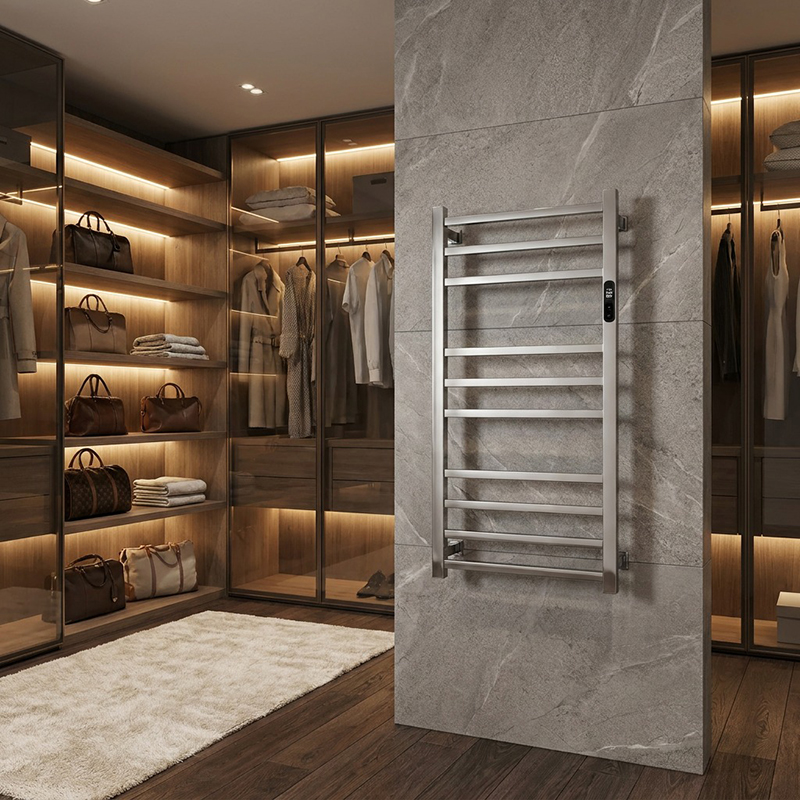
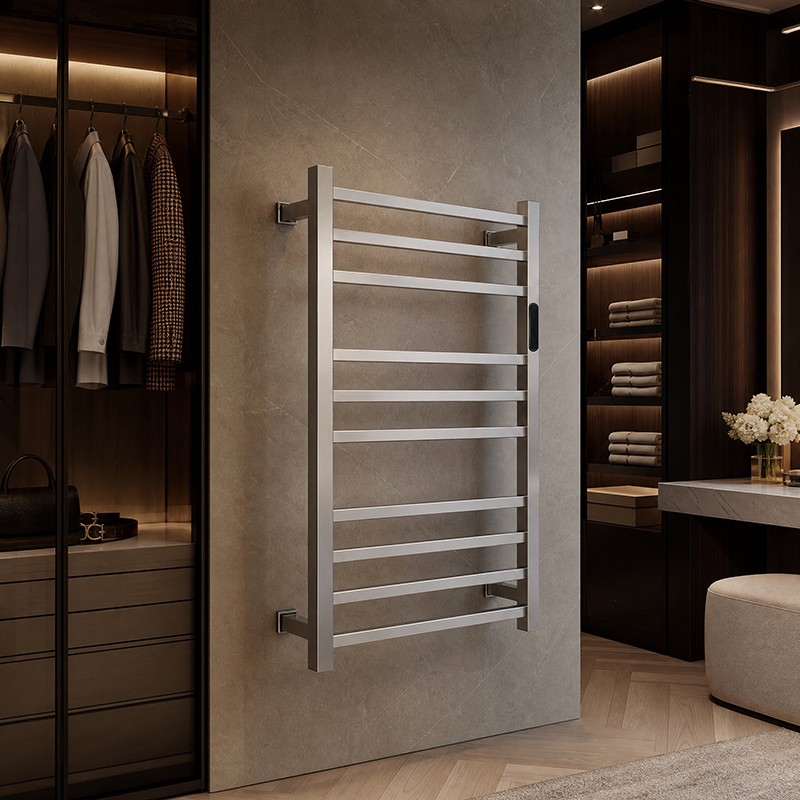
Specifying high-grade fixtures, such as a premium hot towel warmer, ensures uniform heat distribution across all horizontal bars, maximizing contact surface area during shorter operating cycles.
Evaluating the 4-Hour Timer Cycle
Extending the heating duration to 4 hours provides the necessary thermal output required for complete moisture dissipation under demanding environmental conditions. This setting is particularly beneficial in high-humidity climates or commercial installations where towels absorb substantial moisture.
A 4-hour operating period proves superior during these scenarios:
- Thick, high-GSM bath sheets used in luxury hotel suites.
- Cold winter seasons where ambient bathroom temperatures retard natural evaporation.
- Enclosed or windowless bathrooms with limited air turnover.
- Towels that have absorbed significant water content after prolonged use.
For commercial developers and contractors sourcing complete hardware packages across our towel warmer collection, integrating robust internal timer relays ensures long-term operational stability under heavy daily cycling.
Thermal Performance & Cycle Comparison
Selecting the correct operating parameters requires analyzing environmental factors against operational requirements. The table below outlines baseline performance criteria across standard operating conditions.
- 2-Hour Operation: Ideal for pre-warming dry towels, light post-shower drying, high ambient humidity control in warm seasons, and low-density textiles.
- 4-Hour Operation: Suited for heavy post-shower drying, dense luxury bath sheets, winter conditions, and environments with minimal natural airflow.
- Advanced Thermostatic Control: Dynamically modulates power draw once peak temperature is achieved, reducing total kilowatt-hour consumption during extended cycles.
"In commercial project specifications, control simplicity directly reduces system downtime and operational errors. Providing intuitive single-touch drying programs ensures guest comfort while safeguarding energy conservation goals."
Advanced Control Interfaces: Beyond Basic Timers
Modern architectural hardware specifications increasingly move away from manual dual-choice timers in favor of integrated intelligent control systems. Simplifying user interaction improves energy compliance while delivering consistent performance.
A single-touch automated drying sequence provides a seamless experience through a refined functional progression:
- Rapid initial ramp-up to target surface temperature.
- Thermostatic regulation to maintain consistent operating heat.
- Sustained thermal output calibrated for complete moisture evaporation.
- Automatic power disengagement at cycle completion to eliminate waste.
Integrating these automated drying features into broader bathroom hardware specifications ensures cohesive aesthetic and functional design. Pair heating solutions with matching hardware, such as a stainless steel towel rack or modern storage elements from our mirror cabinet collection, to create unified, high-performance commercial interior spaces.
Frequently Asked Questions
Can electric towel rail timers be operated on a daily continuous cycle?
Commercial-grade timer relays and thermostatic elements are engineered specifically for repeated daily activation. Selecting fixtures constructed with high-grade heating elements and internal thermal cutoffs ensures long-term stability under continuous commercial usage.
Does a 4-hour timer setting consume double the electricity of a 2-hour setting?
Energy consumption does not always scale linearly with duration. Units equipped with internal thermostats disengage power draw once peak operating temperature is achieved, modulating electricity intake rather than running continuously at full load.
What steps should be taken if towels remain damp after a 4-hour cycle?
If textiles remain moist after an extended cycle, verify that towel placement maximizes direct contact across the heated bars without overloading the unit. Improving ambient room ventilation and lowering humidity levels also significantly increases overall drying efficiency.
Get in Touch for Bulk Orders & Project Support
Looking for a reliable supplier of bathroom and kitchen products?
At Bergoto, we provide premium solutions for wholesalers, distributors, contractors, and project buyers worldwide.
- Competitive factory pricing
- OEM & ODM support
- Stable supply for large-scale projects
📩 Email: teli@bergoto.com
📞 WhatsApp/WeChat: +86 18923119142
Our team will respond within 24 hours.