
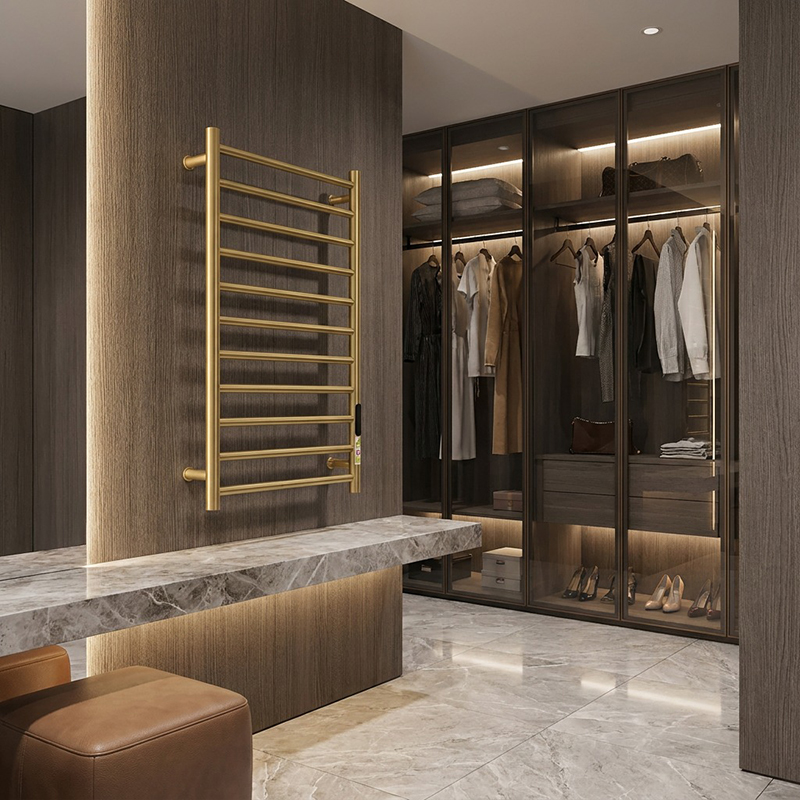
Can You Leave a Heated Towel Rail On 24/7? A Commercial Specification & Energy Guide
Ask whether an electric heated towel rail should run continuously and you will encounter sharply divided opinions. Operational traditionalists often argue that leaving a rail powered on indefinitely maintains constant comfort, while energy-conscious facility managers point to unnecessary kilowatt-hour accumulation. For hospitality procurement executives, MEP engineers, and commercial developers, resolving this operational debate requires examining thermal efficiency, duty cycles, and internal safety engineering.
The short answer is that while high-grade electric towel warmers can safely run around the clock, continuous operation is rarely the most cost-effective or energy-efficient strategy. Modern thermostatic controls and automated timers allow property operators to deliver warm, dry linens while minimizing operational expenditure across major facilities.
Core Engineering Principle: Operating a heated towel rail continuous 24/7 depends on thermal management, controller stability, and real-world duty cycles. Modern dry-element systems with thermostatic regulation prevent thermal runaway, making scheduled automation far more energy-efficient than uninterrupted power draw.
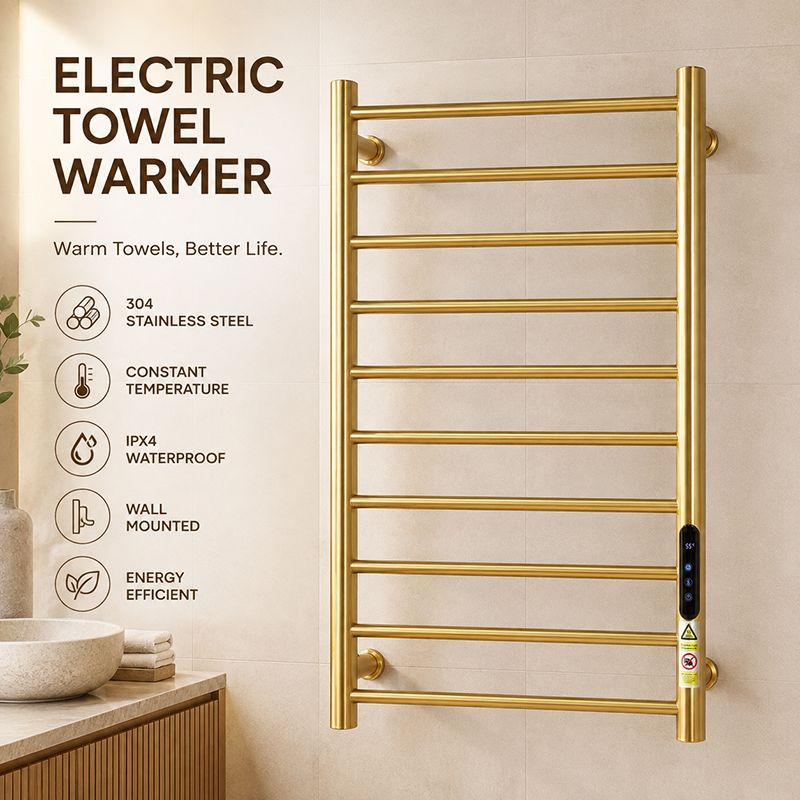
1. Component Design and Duty Cycle Ratings
Whether a heated towel rack handles continuous electrical load depends primarily on its internal heating architecture. Low-wattage dry-element systems utilizing internal alloy heating wires are engineered for sustained thermal emission. Conversely, fluid-filled rails relying on immersion heating elements experience internal hydraulic pressure fluctuations during extended heating cycles.
When selecting fixtures for high-traffic commercial projects, specifying durable materials like 304-grade stainless steel ensures structural integrity under continuous heating. Sourcing through specialized manufacturing channels, such as our curated towel warmer collection, guarantees that internal heating elements maintain stable resistance levels throughout prolonged duty cycles.
Units built specifically for timed or intermittent operation often utilize simplified control boards. Subjecting these lighter-duty controllers to constant electrical load without passive heat dissipation can accelerate thermal degradation of the circuit components, eventually leading to premature board failure.
2. Overheat Protection and Safety Architecture
Evaluating continuous operation requires looking beyond normal function to examine how a system responds under failure conditions. If a primary temperature controller fails in the closed position, robust secondary safety mechanisms must immediately interrupt power supply to prevent surface temperatures from exceeding safe operational thresholds.
Commercial-grade electric towel rails incorporate multiple redundant safety layers:
- Integrated thermal cutoffs (TCO) that physically break the electrical circuit at predetermined temperature limits.
- NTC thermistors that continuously report surface conditions to microprocessor controllers.
- Self-regulating PTC ceramic elements that naturally decrease electrical current draw as temperatures rise.
- Flame-retardant internal wiring insulation rated for prolonged thermal exposure.
In luxury hospitality environments, installing a commercial-grade hot towel warmer with built-in thermal protection safeguards guest comfort while protecting building assets against electrical overloads.
3. User Demand vs. Scheduled Heating Cycles
In residential and hotel settings, bathroom occupancy follows distinct daily patterns. Towel warming is primarily required during morning and evening bathing hours, while post-shower drying requires an extended post-use cycle to evaporate trapped textile moisture.
Running a unit continuously during unoccupied overnight hours or mid-day periods generates ambient space heat that mechanical cooling systems must counteract in warmer seasons. A structured operational schedule delivers superior efficiency while maintaining full utility:
- Preheat the rail 30 to 45 minutes prior to peak occupancy periods.
- Maintain target operating temperature during active bathing hours.
- Extend the heating cycle for 2 to 4 hours post-use to ensure thorough moisture evaporation.
- Disengage heating automatically once textiles are fully dry.
Integrating towel warming fixtures alongside complementary bathroom hardware, such as a premium stainless steel towel rack or modern storage elements from our mirror cabinet collection, ensures cohesive space planning while optimizing functional storage zones.
4. Analyzing Energy Costs and Lifetime Duty Hours
Although individual electric towel rails feature relatively modest power ratings (typically ranging from 60 to 180 watts), continuous 24/7 operation accumulates substantial kilowatt-hour totals over a year. Multiplied across a 200-room hotel facility, unchecked continuous operation significantly inflates utility budgets.
- Continuous 24/7 Operation: A 100W rail operating continuously consumes 2.4 kWh per day, equaling approximately 876 kWh annually per unit.
- Automated 6-Hour Daily Cycle: Operating the same 100W rail on a scheduled timer consumes 0.6 kWh per day, or 219 kWh annually, representing a 75% energy reduction.
- Thermostatic Modulation: High-efficiency units cycling power once reaching operating equilibrium further reduce total active power draw.
"In commercial project development, operational longevity is directly tied to total thermal stress. Implementing dynamic thermostatic controls protects internal heating elements, extending product service life while drastically lowering property operating costs."
5. Decision Matrix: Continuous vs. Timed Operation
Choosing between continuous running and automated timer control depends on specific project requirements, ambient climate conditions, and hardware specifications.
Continuous 24/7 operation is appropriate primarily when:
- The unit serves as a primary auxiliary heat source in cold climate zones.
- The installation uses low-wattage, self-regulating heating wire systems specifically rated for non-stop operation.
- High-humidity environments require ongoing ambient air drying to suppress mold and mildew growth.
Timed thermostatic operation is recommended when:
- Primary goals focus on guest towel warming and rapid post-use drying.
- Facilities must comply with commercial energy efficiency targets and sustainability metrics.
- Building management aims to maximize total service lifespan across electronic control boards.
Frequently Asked Questions
Is it safe to leave a heated towel rail running overnight?
Leaving a certified heated towel rail powered overnight is safe provided the unit features integrated thermal cutoffs and overheat protection. However, utilizing an automated timer to shut the unit off after towels are dry prevents unnecessary power consumption during low-use hours.
Should towel warmers be switched off during extended facility vacancies?
Powering off heating units during multi-day vacancies or seasonal facility shutdowns is strongly recommended. De-energizing the system eliminates standby electrical draw, prevents unintended heat buildup, and preserves component longevity.
Does running a heated towel rail non-stop reduce its operational lifespan?
Continuous operation accelerates the accumulation of active thermal hours across heating wires, thermistors, and internal control boards. High-quality stainless steel rails resist degradation well, but automated cycling preserves electronic components over longer operational periods.
Get in Touch for Bulk Orders & Project Support
Looking for a reliable supplier of bathroom and kitchen products?
At Bergoto, we provide premium solutions for wholesalers, distributors, contractors, and project buyers worldwide.
- Competitive factory pricing
- OEM & ODM support
- Stable supply for large-scale projects
📩 Email: teli@bergoto.com
📞 WhatsApp/WeChat: +86 18923119142
Our team will respond within 24 hours.