

Does a Heated Towel Rail Use a Lot of Electricity? Real Energy Calculations & B2B Sourcing Guide
When specifying electric heating fixtures for luxury residential developments or large-scale hotel projects, energy efficiency directly influences operating budgets and green building certifications. A common consumer assumption is that a low rated wattage automatically translates to minimal electrical consumption. However, calculating true operational expenditure requires evaluating energy consumption through complete heating cycles rather than relying solely on nominal nameplate ratings.
Understanding how power output translates into real-world utility costs allows MEP contractors, hospitality procurement managers, and hardware distributors to select heating systems that strike the right balance between rapid moisture evaporation and responsible energy management.
Core Engineering Principle: Real-world energy consumption depends on the total kilowatt-hours (kWh) required to achieve a dry, hygienic towel, not merely the hourly wattage rating. Thermostatically controlled systems optimize electrical draw by cycling power once operating equilibrium is established.
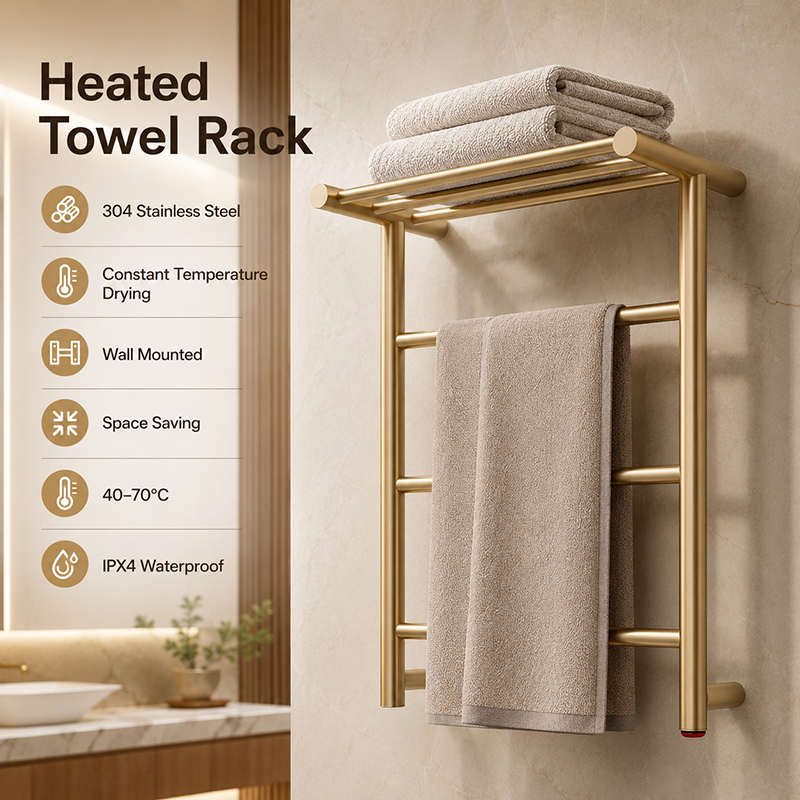
Calculating Baseline Electrical Consumption
Determining the baseline energy draw of an electric heated towel rail involves a straightforward formula. Converting the unit's rated power output from watts to kilowatts provides the foundational metric for assessing utility impacts over specific operational durations.
Consider a standard hotel-grade heated rail rated at 60 watts. Dividing 60 watts by 1,000 yields a power demand of 0.06 kilowatts (kW). Running this unit continuously across a typical 4-hour post-shower drying cycle equates to the following consumption profile:
0.06 kW × 4 hours = 0.24 kilowatt-hours (kWh) per cycle.
Multiplying this 0.24 kWh figure by regional commercial electricity rates reveals the exact cost per drying cycle. Across a 300-room hospitality facility, small efficiencies calculated at the individual fixture level compound into substantial annual operational savings.
Why Actual Power Draw Is Often Lower Than Nameplate Wattage
Calculations based strictly on nominal wattage assume continuous 100% electrical output, which rarely reflects modern fixture engineering. Advanced electric towel warmers incorporate thermostatic controls and internal thermal cutoffs that actively regulate power draw once target surface temperatures are reached.
Thermostatic heating elements modulate energy intake through three distinct operational behaviors:
- Temporarily interrupting power flow when internal resistance signals optimal heat saturation.
- Throttling voltage output to maintain steady-state surface warmth rather than driving continuous temperature rise.
- Pulsing current back on only when ambient thermal dissipation causes surface temperatures to drop below set thresholds.
For commercial developers sourcing premium hardware, specifying dry-element systems from our specialized towel warmer collection ensures consistent thermal retention without continuous full-load electrical draw.
The Wattage Fallacy: Low Wattage vs. Total Energy per Useful Result
A widespread misconception in building specification is treating lower nameplate wattage as an absolute proxy for superior energy efficiency. Comparing two distinct operational profiles highlights why evaluating total cycle duration yields a more accurate performance metric.
Consider Product A, engineered with a minimal 40W rating, and Product B, built with a robust 100W output. If Product A requires an 8-hour continuous run time to fully dry a heavy 600 GSM bath towel due to weak thermal output, its total consumption reaches 0.32 kWh (0.04 kW × 8 h). Conversely, if Product B delivers higher heat density and achieves complete textile drying in just 2.5 hours, its total consumption equals only 0.25 kWh (0.10 kW × 2.5 h).
Evaluating fixtures based on "energy per useful result" ensures commercial projects achieve rapid fabric drying without extending heating cycles unnecessarily.
Thermal Output & Efficiency Comparison
Selecting appropriate heating specifications requires balancing nominal power output against target room conditions and textile densities. The table below outlines key operational differences across standard commercial fixture categories.
- Low-Wattage Units (40W - 60W): Best suited for pre-warming dry towels or light post-shower drying in warm, low-humidity environments. Extended run times required for damp luxury textiles.
- Medium-Wattage Units (70W - 120W): The optimal specification for hospitality installations. Delivers rapid thermal conduction to penetrate heavy cotton layers while benefiting from thermostatic modulation.
- High-Output Units (130W+): Designed for spacious master suites or cold climate zones where the fixture serves a dual role of towel drying and auxiliary space heating.
"In commercial project procurement, specifying heating fixtures based solely on initial wattage ratings often leads to longer operational cycles. True efficiency lies in rapid thermal recovery and precise cycle automation."
Optimizing Hardware Integration in Commercial Design
Maximizing energy efficiency extends beyond the heating element itself. Integrating heated towel rails into comprehensive interior hardware packages ensures cohesive spatial design while maintaining optimal environmental performance across hospitality and residential spaces.
Pairing a high-efficiency hot towel warmer with matching storage infrastructure allows project designers to optimize wall layouts. Incorporating non-heated structural storage, such as an architectural stainless steel towel rack or modern storage units from our mirror cabinet collection, prevents overcrowding on the heated bars—improving airflow and accelerating natural drying rates.
Frequently Asked Questions
Is a 60W towel rail always cheaper to run than a 100W model?
Not necessarily. If a 100W rail dries a damp towel in half the time required by a 60W unit, its total kilowatt-hour consumption per drying cycle may be lower, resulting in lower total electricity costs.
Do digital timer controllers consume standby electricity?
Modern electronic controllers utilize micro-amp standby circuits that draw minimal power (typically under 0.5 watts) while idle. This negligible standby load is vastly offset by the energy saved through automated cycle shutoffs.
How can commercial facility managers measure real-world towel warmer power usage?
Facility managers can measure actual power draw by deploying inline plug-in power meters or monitoring circuit-level electrical loads during controlled 2-hour and 4-hour drying tests under standard ambient bathroom conditions.
Get in Touch for Bulk Orders & Project Support
Looking for a reliable supplier of bathroom and kitchen products?
At Bergoto, we provide premium solutions for wholesalers, distributors, contractors, and project buyers worldwide.
- Competitive factory pricing
- OEM & ODM support
- Stable supply for large-scale projects
📩 Email: teli@bergoto.com
📞 WhatsApp/WeChat: +86 18923119142
Our team will respond within 24 hours.