
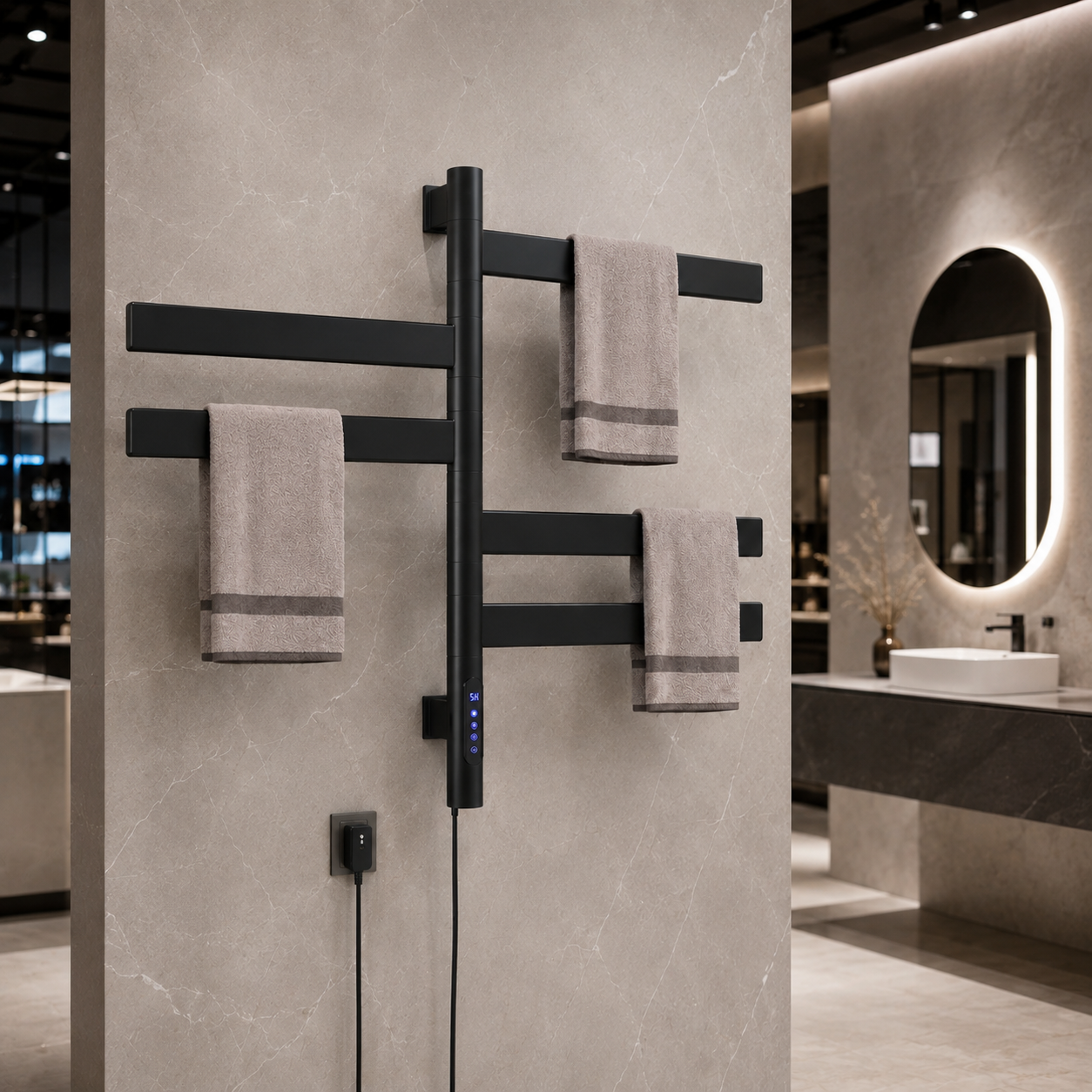
How Long Should a Heated Towel Rail Take to Heat Up? A Real-World Performance Guide
In the commercial sanitary ware industry, "fast heating" has become one of the most widely used marketing claims for electric towel warmers. However, for project specifiers, hoteliers, and wholesale distributors, marketing claims often obscure operational realities. There is a distinct engineering difference between when a rail begins to generate surface warmth and when it reaches its stable operating equilibrium.
Evaluating heat-up performance requires looking beyond superficial metrics. Understanding thermal dynamics allows B2B buyers to select products that meet client expectations while maintaining long-term energy efficiency and guest satisfaction.
Decoding the "5-Minute Heating" Claim
When manufacturers cite a five-minute warm-up time, they are typically measuring initial thermal activation rather than complete system readiness. Within the first few minutes, internal heating elements (whether dry-carbon wiring or liquid-filled fluid) initiate thermal transfer, causing the external metal surface to feel warm to a casual touch.
Achieving maximum working temperature across the complete frame requires significantly more time. Heat must migrate from the central heating core through the metal walls and across all horizontal bars, a process governed by thermal conductivity and ambient room conditions.
The Three Stages of Towel Warmer Thermal Activation
To establish accurate performance standards for commercial projects, thermal performance should be analyzed across three distinct operational phases:
- Stage 1: Initial Activation (0–5 Minutes): The primary internal heating element energizes. Surface temperature rises slightly above ambient, providing initial tactile warmth at core contact points.
- Stage 2: Cross-Bar Thermal Conduction (5–15 Minutes): Heat spreads through vertical struts and horizontal bars. The entire frame warms up, though subtle temperature gradients may remain between upper and lower bars.
- Stage 3: Thermal Equilibrium (15–30 Minutes): The unit reaches its target operating range (typically 50°C to 55°C). Internal thermostats begin modulating power to maintain stable heat output without overheating.

Core Technical Factors Influencing Warm-Up Speed
Why do two towel rails with identical wattage ratings perform differently in real-world hospitality environments? Several physical and structural variables determine heating velocity.
Material Selection and Structural Design
Material conductivity dictates thermal transfer rates. High-grade stainless steel offers an optimal balance of corrosion resistance, structural rigidity, and swift thermal transfer. For instance, specialized units like the Sweden & Denmark style electric heated drying rack utilize optimized wall thicknesses to accelerate thermal output without compromising structural integrity.
"In high-end commercial projects, material thickness and internal conductivity matter far more than raw wattage. Efficient heat distribution prevents localized hot spots while minimizing overall energy consumption."
Wattage Distribution vs. Frame Mass
Higher wattage generally increases heating speed, but it must be proportional to overall surface area. Overpowering a small rail creates surface burning risks, whereas underpowering a large frame results in sluggish performance. Commercial buyers should evaluate wattage per linear bar meter rather than total rated capacity alone.
Real-World Load Testing: The Impact of Damp Towels
Unloaded heating speed offers only a baseline measurement. In actual hotel or residential settings, the primary function of a towel warmer is drying wet textiles. Water absorbs substantial thermal energy during evaporation, creating a cooling effect on the rail surface.
When loaded with a standard damp cotton bath towel, the time required to reach stable operating temperatures can increase by 40% to 60%. High-performance engineering ensures that the heating element provides sufficient energy buffer to drive off moisture while keeping towels pleasantly warm.
Evaluating Towel Warmers: A B2B Buyer Checklist
When reviewing commercial specifications across various towel warmer collections, request the following verified test metrics from suppliers:
- Time to initial warmth (unloaded)
- Time to full thermal equilibrium (50°C–55°C target)
- Drying cycle duration under a standard wet towel load
- Internal heating technology (dry carbon cable vs. fluid-filled heating)
Matching Towel Warmers to Architectural Spaces
Modern luxury bathrooms demand cohesive architectural aesthetics alongside functional reliability. A complete bathroom specification often integrates heated towel bars with complementary fixtures, such as specialized LED mirror solutions or integrated bathroom vanity collections, ensuring consistent material finishes and electrical safety standards across the entire space.
For minimalist project layouts, multi-functional hardware—such as a hotel-style stainless steel towel rack—provides flexible storage while maintaining sleek visual continuity.
Conclusion
Evaluating heated towel rail performance requires a clear distinction between initial surface warming and full operating equilibrium. While initial warmth typically occurs within 5 minutes, achieving stable, effective drying performance takes approximately 15 to 30 minutes depending on material construction, frame mass, and environmental conditions. For commercial importers and project contractors, prioritizing balanced wattage, high-grade stainless steel construction, and verified thermal equilibrium metrics ensures superior end-user satisfaction and long-term product durability.
Frequently Asked Questions
Does a 5-minute heating claim mean towels dry in 5 minutes?
No. Initial heating refers only to the surface temperature rise of the metal rail. Drying a damp towel involves moisture evaporation, which typically requires a stable thermal cycle lasting between 1.5 to 3 hours under continuous operating temperatures.
Does higher wattage always guarantee faster heating?
Not necessarily. While higher wattage provides greater heating capacity, speed is strongly influenced by internal element design, metal density, and wall thickness. An over-wattage rail without proper internal regulation can lead to uneven heating or unsafe surface temperatures.
Why do electric towel rails seem slower to heat during winter months?
Lower ambient bathroom temperatures increase heat dissipation from the metal surface into the surrounding air. Consequently, the rail loses thermal energy faster, slightly extending the time needed to reach full thermal equilibrium.
Get in Touch for Bulk Orders & Project Support
Looking for a reliable supplier of bathroom and kitchen products?
At Bergoto, we provide premium solutions for wholesalers, distributors, contractors, and project buyers worldwide.
- Competitive factory pricing
- OEM & ODM support
- Stable supply for large-scale projects
📩 Email: teli@bergoto.com
📞 WhatsApp/WeChat: +86 18923119142
Our team will respond within 24 hours.