
Why Your Heated Towel Rail Is Warm but the Towel Stays Damp (And How B2B Buyers Solve It)
A common complaint in residential developments, commercial projects, and luxury hotel suites involves a puzzling contradiction: the electric heated towel bar feels hot to the touch, yet hours later, the center of the bath sheet remains noticeably damp. When property managers, MEP contractors, or hospitality project buyers encounter this issue, the immediate assumption often points toward heating element failure or insufficient wattage output.
In most commercial and residential installations, the root cause extends beyond simple thermal output. Effective moisture elimination relies on a balanced thermodynamic relationship between heat transfer, local atmospheric ventilation, and spatial air movement. Understanding these underlying mechanisms allows project specifiers and wholesale distributors to select the right fixtures and provide accurate usage guidance for high-end developments.
The Physics of Towel Drying: Three Essential Variables
Evaporative drying requires more than elevated surface temperatures. When moisture is trapped deep within heavy multi-ply cotton fibers, three distinct physical conditions must operate in harmony to achieve complete dryness.
- Thermal Conduction and Radiation: Heat provides the sensible energy required to transition liquid water into vapor. Higher temperatures accelerate this phase change, but heat alone cannot disperse the resulting water vapor.
- Air Circulation and Vapour Pressure: As liquid evaporates from the fabric, it creates a micro-layer of saturated air directly surrounding the towel fibers. Without adequate airflow to displace this saturated air, localized relative humidity reaches equilibrium, stalling further evaporation.
- Sustained Exposure Time: Thick, high-GSM (grams per square meter) luxury bath sheets retain significant moisture volumes deep within their woven core. Thermal energy requires time to penetrate these multi-layered structures completely.
Common Hanging Errors and Spatial Constraints
In hotel guest rooms and multi-family residential units, user habits frequently compromise the performance of even commercial-grade fixtures. The structural design of the rack must account for how end users interact with the hardware daily.
Excessive Layer Folding
When a thick bath towel is folded into four layers to fit a narrow bar, the outer surface directly touching the heated stainless steel absorbs thermal energy rapidly. However, the inner layers become insulated. Moisture evaporated from the interior gets trapped between fabric layers, creating a warm, damp core that fails to dry.
Overloading Available Bar Space
Draping multiple heavy towels across every available rung creates a continuous fabric wall. This arrangement severely restricts convective air currents that would normally flow upward between the horizontal bars, significantly extending the required drying cycle.
Inadequate Wall Clearance
Installing a heated rack too close to the finished wall surface limits air movement behind the fixture. When towels press firmly against both the heated bar and the tiled wall, moisture becomes trapped against the cold wall surface, leading to condensation build-up rather than evaporation.
"Thermal efficiency in architectural bath hardware depends as much on physical airflow pathways as it does on internal heating element output. Proper spacing and structural clearance are critical specification parameters."
Structural and Material Solutions for Project Specifiers
For distributors, project contractors, and hotel procurement directors, selecting the correct hardware specifications prevents end-user complaints regarding damp linens.
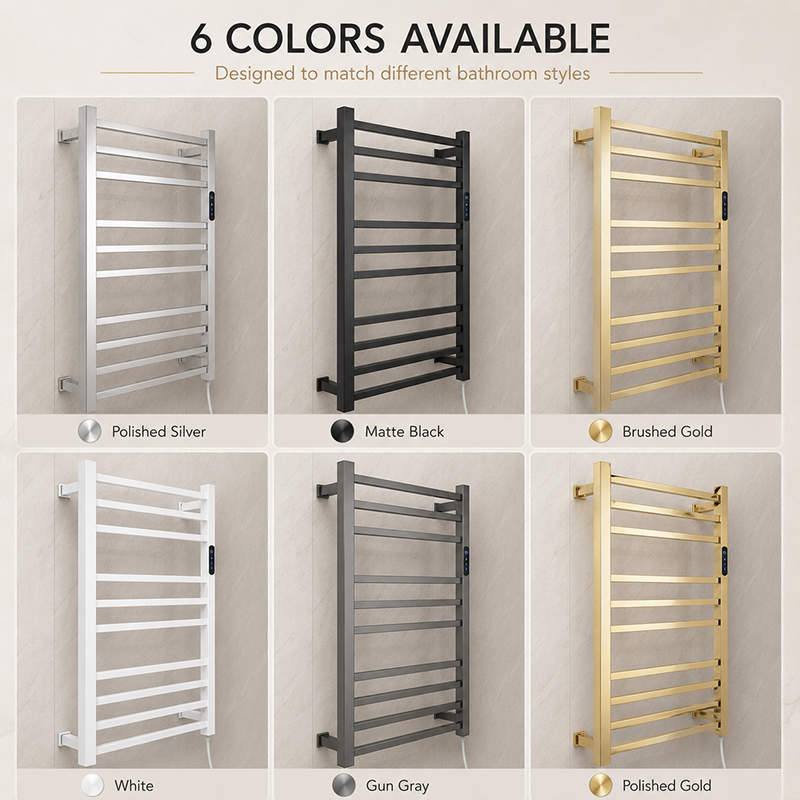
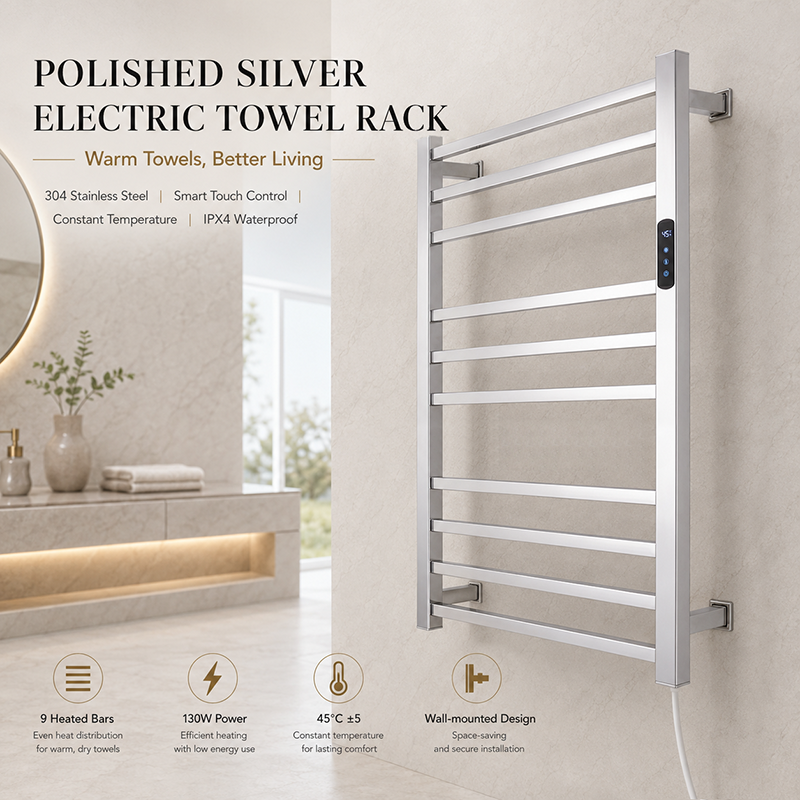
When sourcing commercial fixtures, selecting high-conductivity materials ensures rapid, uniform thermal transfer across all rungs. Choosing robust electric heated drying rack spa towel bars manufactured from premium stainless steel provides long-term corrosion resistance in humid environments while maintaining consistent surface heating across the entire frame.
For modern hospitality projects, pairing heated drying racks with space-efficient storage and proper ventilation creates an integrated guest experience. Utilizing wall-mounted layout solutions like stainless steel hotel style towel racks provides guest rooms with dedicated holding areas for dry, folded linens, keeping heated bars free specifically for active drying.
Drying Performance Comparison Matrix
Understanding how different operational setups impact drying efficiency helps B2B buyers recommend the ideal configuration for commercial developments:
- Multi-Fold Draping on Low Wattage Rail: High surface warmth, restricted internal vapor release, extended drying time (6+ hours).
- Single-Layer Draping with Mechanical Ventilation: Optimal heat transfer, rapid vapor displacement, fast drying time (2–3 hours).
- Overloaded Rail in Unventilated Ensuite: Uneven heating, trapped ambient moisture, risk of musty odor accumulation.
Optimizing the Broader Bathroom Ecosystem
A heated towel bar operates within a broader architectural environment. Achieving rapid drying performance requires evaluating adjacent fixtures and environmental controls during the design phase.
To maintain optimal humidity levels, combining heated drying hardware with organized storage and functional lighting mirrors completes the functional zone. Exploring complete towel warmer collections alongside integrated LED mirror cabinets allows commercial planners to streamline electrical rough-ins and ensure unified aesthetic finishes across luxury residential and commercial projects.
Furthermore, mechanical exhaust systems should be calibrated to run during and after shower use. Active ventilation lowers the room's baseline relative humidity, allowing airborne moisture from the towel rack to dissipate efficiently into the exhaust stream.
Frequently Asked Questions
Why does a towel rail feel hot while the towel center remains damp?
The heat from the bar increases evaporation, but if the towel is folded multiple times, moisture cannot escape the inner layers. Without convective airflow around the fabric, trapped water vapor condenses back into the cotton fibers.
How long should a commercial heated towel rail take to dry a standard bath sheet?
Under normal room conditions (20°C to 22°C with adequate exhaust ventilation), a single layer of medium-weight bath towel typically dries within 2 to 3 hours. Heavier luxury bath sheets over 600 GSM may require 4 to 5 hours of continuous operation.
Does room ventilation impact towel rack drying efficiency?
Yes. Mechanical exhaust fans remove saturated air from the bathroom. Lowering ambient relative humidity increases the vapor pressure differential, allowing moisture to evaporate from the towel surface much faster.
Are heated towel rails intended to act as space heaters or clothes dryers?
Heated towel rails are designed primarily to warm dry towels, assist in drying lightly damp towels post-shower, and prevent microbial growth. They are not intended to replace mechanical clothes dryers for dripping-wet laundry loads.
Get in Touch for Bulk Orders & Project Support
Looking for a reliable supplier of bathroom and kitchen products?
At Bergoto, we provide premium solutions for wholesalers, distributors, contractors, and project buyers worldwide.
- Competitive factory pricing
- OEM & ODM support
- Stable supply for large-scale projects
📩 Email: teli@bergoto.com
📞 WhatsApp/WeChat: +86 18923119142
Our team will respond within 24 hours.