
What IP Rating Does a Bathroom Mirror Need?
IP44 satisfies the standard. It does not always survive how hotels actually clean their bathrooms. Here are the zones, the numbers behind the test conditions, and what to write into the tender.
For a bathroom LED mirror, the standard minimum is IP44 in Zones 1 and 2 under IEC 60364-7-701, and IPX7 for any fitting inside Zone 0. Where the room is cleaned with pressurised water jets, the requirement rises to IPX5 — so most hospitality programmes should specify IP65 and stop arguing about it.
Key takeaways
- IP ratings describe water and dust ingress only. They say nothing about cleaning chemicals, humidity ageing or UV.
- The zone is decided by distance from the bath or shower tray, not by how "wet" the room feels. A basin on its own does not create zones.
- IPX4 was designed for splashing. A commercial cleaning lance delivers more water at far higher pressure than the test nozzle.
- Failures almost never start at the front glass. They start at the cable entry, the driver and the diffuser seal.
- In North America, specify damp or wet location listing rather than quoting an IP code your electrician cannot verify against a listing mark.
Every LED bathroom mirror on every supplier site carries an IP rating. Almost none of them say what happens to it if a housekeeper aims a pressure lance at the wall behind it for ninety seconds, which is roughly how long it takes to clean a hotel bathroom to standard.
That gap is not a technicality. It is the difference between a fitting that lasts the fifteen-year design life written into the FF&E schedule and one that starts misting behind the glass in year three — by which point the room has been handed over, the defects period has closed, and nobody agrees whose specification was wrong.
This piece sets out where the IP requirement actually comes from, what the numbers in the test mean, why the zone map catches people out, and what to write into a tender so the rating survives contact with the people holding the cleaning equipment.
The short answer, and where it comes from
The requirement does not originate from the mirror industry. It comes from the wiring regulations for locations containing a bath or shower — internationally IEC 60364-7-701, implemented in the UK as Section 701 of BS 7671 and mirrored in national codes across Europe and much of Asia Standard. The regulation divides the room into zones and assigns each zone a minimum ingress protection level. The mirror picks up whatever its position falls into.
The practical answer most specifiers need is simple: IP44 is the baseline for a mirror mounted above a basin in a wet room, and IP65 is the sensible specification for any hospitality programme. The rest of this article explains why those two numbers are not in conflict, and which procurement decisions each one drives.
What the two digits actually test
An IP code is two digits and nothing more. The first covers solid ingress. The second covers liquid ingress. There is no third digit, no temperature performance, no chemical resistance, no UV stability hidden in the number — which surprises people who assume a high IP code implies general robustness.
| Code | Protection claimed | Approximate test conditions | Real-world equivalent |
|---|---|---|---|
| IPX4 | Splashing water from any direction | Oscillating spray or hand-held spray, roughly 10 litres per minute, about 5 minutes, low pressure | A shower running nearby; wiping down with a wet cloth |
| IPX5 | Low-pressure water jets from any direction | 6.3 mm nozzle, about 12.5 litres per minute at roughly 30 kPa, from 3 metres, around 3 minutes | A pressurised cleaning lance from across the room |
| IPX6 | Powerful water jets from any direction | 12.5 mm nozzle, about 100 litres per minute, from 3 metres | Close-range high-pressure washing |
| IPX7 | Temporary immersion | 30 minutes at 1 metre depth | Flooding; fitting inside a bath or shower tray zone |
Read the third column rather than the second and the purchasing decision becomes obvious. A domestic shower head delivers something in the order of 8 to 10 litres per minute at mains pressure, spread over a wide cone — comfortably within what IPX4 is designed to reproduce. A commercial cleaning lance is far more concentrated, and the operator is aiming it deliberately at the fitting rather than letting spray drift onto it.
This is also why the standard itself already anticipates the problem. Where a location is cleaned with water jets, the regulations raise the requirement in Zones 1 and 2 from IPX4 to IPX5 Standard.
Zones: how far does the requirement reach?
Zones are geometric, not judgemental. They are measured from the bath or shower tray, and this is where most specifications quietly go wrong, because the mirror is usually not near either.
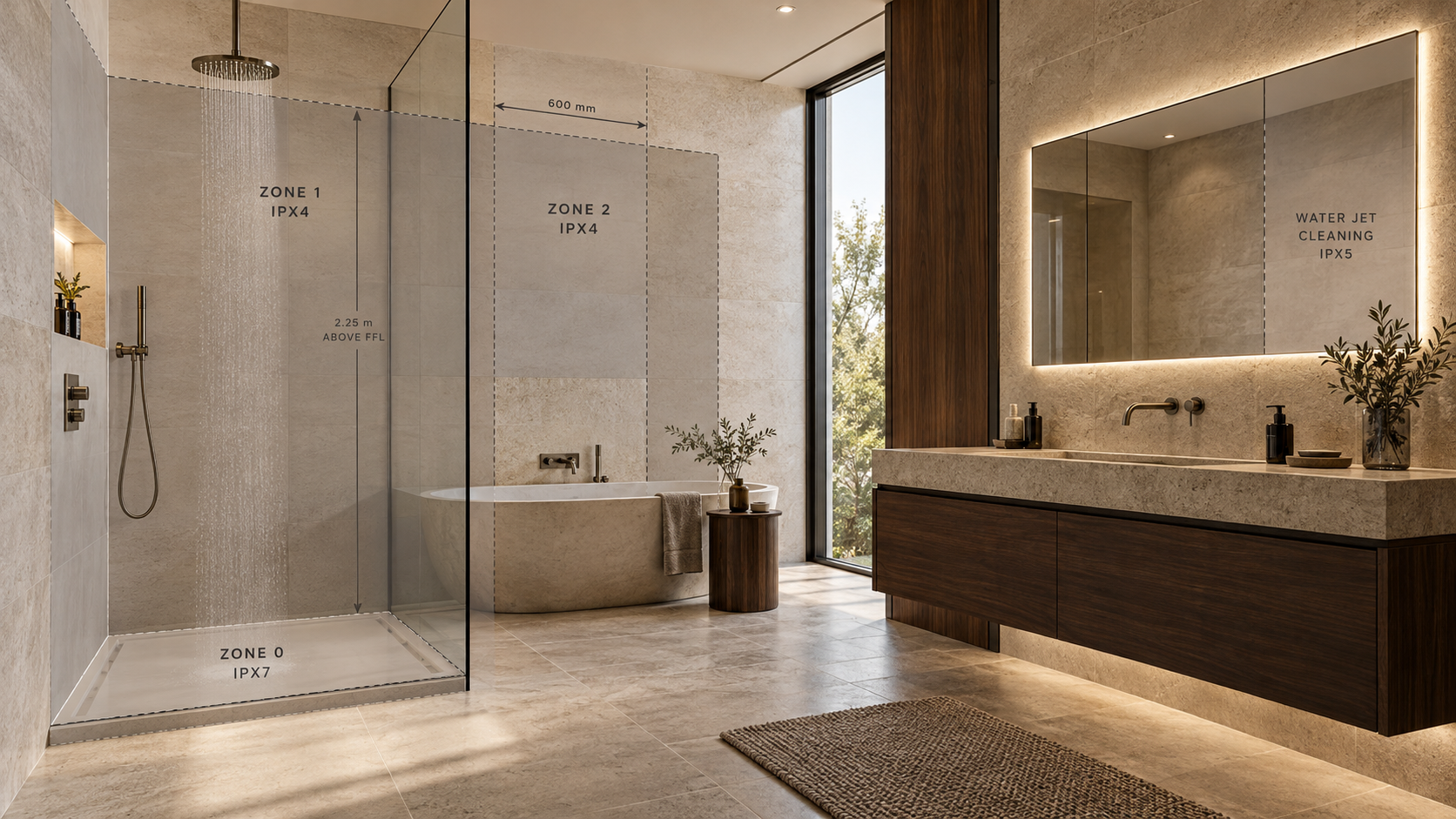
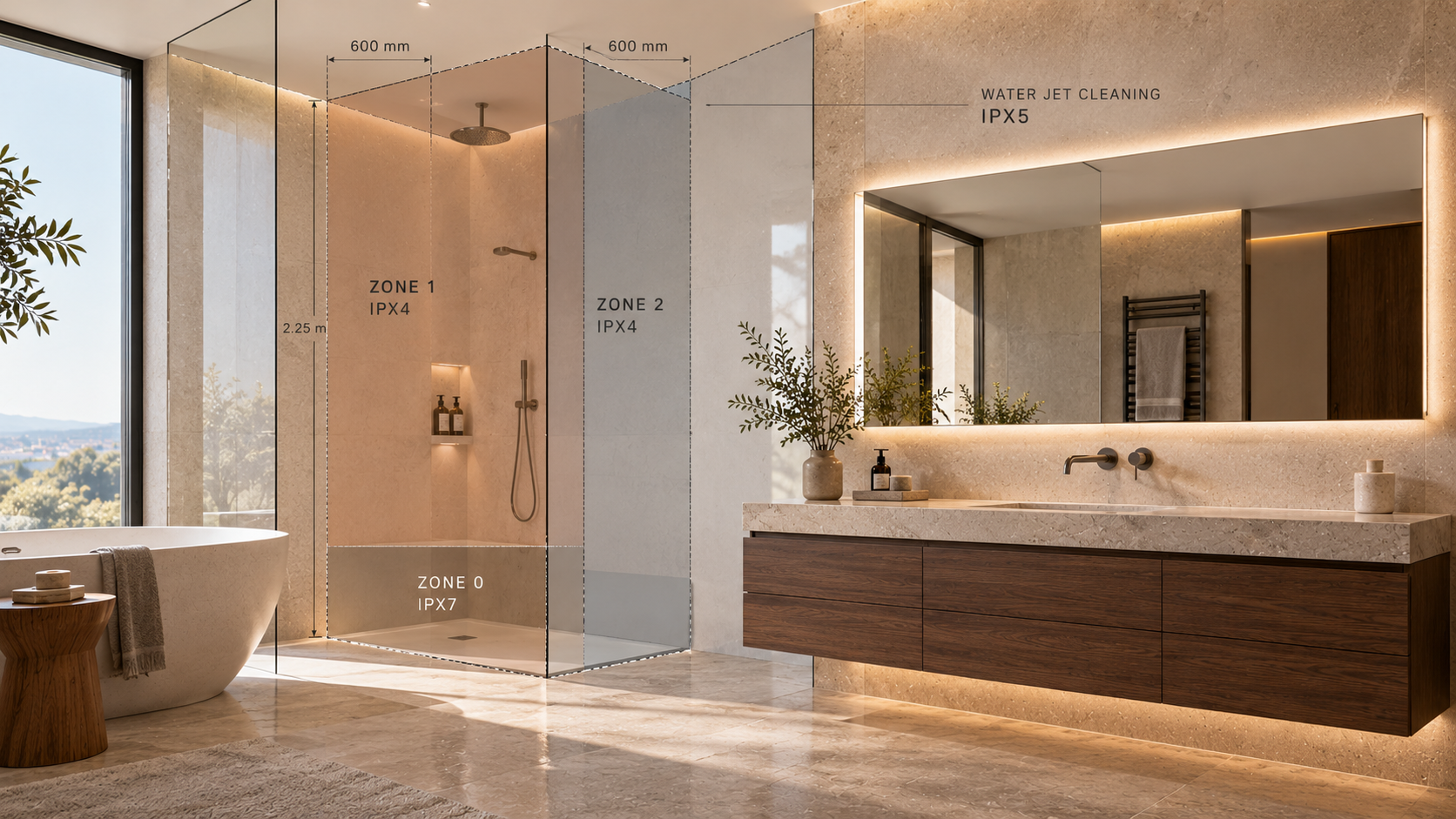
| Zone | Defined by | Minimum requirement | Typical relevance to mirrors |
|---|---|---|---|
| Zone 0 | The interior of the bath or shower tray | IPX7, and equipment supplied at SELV 12 V | Almost never relevant to a wall mirror |
| Zone 1 | Above Zone 0, up to 2.25 m above the finished floor level | IPX4 (IPX5 where water jets are used) | A mirror over the bath falls here |
| Zone 2 | 600 mm horizontally beyond Zone 1, also up to 2.25 m | IPX4 (IPX5 where water jets are used) | Mirrors adjacent to an open shower |
| Outside zones | Everything else in the room | No specific IP requirement, general rules apply | Most hotel vanity mirrors |
Two consequences follow that people routinely get wrong. First, a basin does not create zones. The zones are drawn from the bath or shower tray; a hand basin is treated as a water-containing vessel, not as a zone origin.
Second, 2.25 m is higher than most people think. In a hotel room with a standard ceiling, the entire shower area up to that line is Zone 1 or 2. A tall illuminated mirror mounted close to the shower will often fall inside a zone.
Three ways bathroom mirrors actually fail
1. Diffuser misting and staining
The first symptom is cosmetic. Condensation forms on the inside face of the acrylic diffuser, then dries, then leaves a mineral deposit that no amount of external cleaning removes.
2. Driver failure
The LED driver is the component that dies, and it usually dies because of heat rather than water. Drivers are often mounted in a shallow cavity behind the mirror where there is no airflow.
A remote driver mounted in a ceiling void or service cupboard outside the zones can improve serviceability and reduce thermal stress.
3. Cable entry ingress
The mirror may be IP65 while the cable penetration behind it is not. The cable entry, grommet and installer-applied seal therefore need to be treated as part of the installation detail.
Root cause: certified to a test, exposed to a process
A bathroom mirror is certified against a laboratory test and then installed into a cleaning process nobody tested it against.
The IP code is a property of the product, measured under defined laboratory conditions. The installed result also depends on driver location, cable entry, sealing and the room’s actual cleaning method.
A four-part specification protocol
Step 1 — Ask how the room will be cleaned
If cleaning uses pressurised water, specify IP65. Where cleaning is limited to cloth and light spray, IP44 may remain appropriate subject to the applicable zone requirements.
Step 2 — Review the driver location
Where practical, locate the driver outside the bathroom zones in an accessible ceiling void, service riser or cupboard. If an integral driver is used, confirm its rated maximum ambient temperature.
Step 3 — Specify light quality separately
Ingress protection does not define light quality. CRI, colour temperature, vertical illuminance and demister performance should be specified separately.
Step 4 — Draw the cable entry
Show the cable entry method on the electrical detail and identify the required grommet or compression gland rather than leaving the sealing method to site interpretation.
Europe and North America are not the same question
- Europe, UK, much of Asia and the Middle East: specification commonly uses IP codes against bathroom-zone requirements.
- North America: projects typically rely on damp-location or wet-location listing under the applicable certification and electrical-code system.
There is no exact one-to-one equivalence between these systems, so tender documents should name the required system and evidence rather than use vague wording such as “IP65 or equivalent.”
What to put in the tender
- State the required ingress rating.
- Name the cleaning method.
- Locate the driver.
- Specify light quality numerically.
- Detail the cable entry.
- Ask for cleaning-chemical compatibility.
- Request LED and driver lifetime information.
How Bergoto specifies LED mirrors for projects
Bergoto supplies OEM and ODM bathroom and kitchen products including LED mirrors, LED mirror cabinets, mirror cabinets, bathroom vanities and heated towel rails.
For project LED mirrors, ingress rating, driver strategy, light quality and cable-entry detail should be coordinated before production rather than treated as independent product options.
Frequently asked questions
Is IP44 enough for a bathroom mirror?
IP44 can be appropriate where the applicable bathroom zone requires splash protection and cleaning is limited to cloth or light spray. Where pressurised water jets are used, specify a higher level such as IP65 subject to the applicable project requirements.
Do I need IP65 for a hotel bathroom LED mirror?
Not automatically for every location, but IP65 is a practical hospitality specification where mirrors may be exposed to pressurised cleaning water or where a higher ingress margin is desired.
What is the difference between IP44 and IP65?
IP44 provides protection against objects larger than 1 mm and splashing water. IP65 is dust-tight and protects against low-pressure water jets.
Where do bathroom zones start and end?
Under IEC 60364-7-701, Zone 0 is inside the bath or shower tray, Zone 1 extends above it to 2.25 m, and Zone 2 extends 600 mm horizontally beyond Zone 1. A basin alone does not create a bathroom zone.
Does an IP rating cover cleaning chemicals?
No. IP testing addresses ingress of water and solid particles. Compatibility with cleaning agents, humidity ageing, UV exposure and thermal conditions should be specified separately.
About these figures
- Standard: bathroom-zone requirements and ingress test terminology should be checked against the current applicable standards and national implementation.
- Estimate — verify: indicative operating values such as flow rates and lighting targets should be confirmed for the actual project.
- Not covered by IP: cleaning chemicals, heat, UV and long-term material ageing require separate specification.
Nothing here substitutes for a project-specific electrical or compliance review. Where there is doubt about zone geometry, cleaning exposure or certification requirements, confirm them before ordering.
Specifying illuminated mirrors for a project?
Send us your cleaning protocol and bathroom layout. We can review the ingress rating, driver arrangement, lighting specification and installation details before production.